

In Online Sports Betting, a line adjustment refers to a “handicap line” that is added to or subtracted from the result before settling the slip. Its purpose is to balance the winning conditions between two sides. The key idea is that a points line is not designed to help you “guess correctly” at random. Instead, it transforms a seemingly uneven matchup into clearer winning conditions, such as how many points a team must win by to cover, or how much they can lose by and still result in a valid outcome. After that, the price reflects how difficult that condition is in terms of risk and potential return.
This article guides you through the core principles of Handicap in a structured way, focusing on How Do Handicaps Work (adding or subtracting points before settlement) and how to read the points line together with the price. The goal is to improve accuracy in selecting spreads without relying on guesswork.
What is Handicap in Betting The Principle of Adjusting Winning Conditions Before Settlement
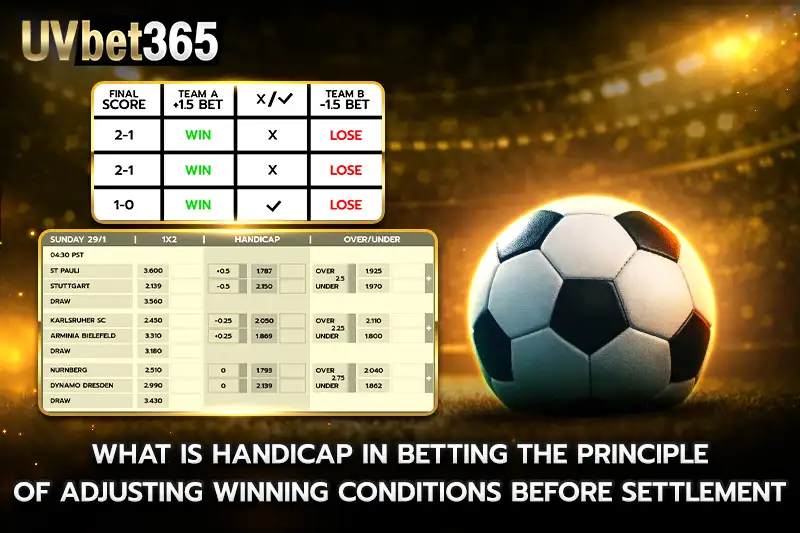
A Handicap in betting means assigning a point advantage or disadvantage to one side, then settling the slip based on the adjusted Score, not the final outcome. In Online Sports Betting, the line offset balances mismatched teams so that the chances of covering the line become more even.
To understand this clearly, focus on three core principles:
- The line defines the winning condition of the slip (it is not a match prediction).
- The actual result is only the starting reference; settlement is based on the adjusted score.
- The price reflects the level of risk in covering the line; it does not guarantee a win.
Another way to visualize this:
- The favorite starts with a negative handicap and must win by a sufficient margin.
- The underdog starts with a positive handicap, giving protection in a narrow loss.
In simple terms, a line adjustment shifts the question from “Who wins?” to “Who meets the condition?”—this is the foundation of accurate line selection.
How Point Spreads Work Adding or Subtracting Before Settlement
In Sports Gambling, a points line works by adding or subtracting a value from the final score before determining the outcome.
Here are short hypothetical examples (to understand the mechanism, not to predict outcomes):
- Favorite at -0.5: the team must win outright. A draw becomes a loss after adjustment.
- Underdog at +1.0: the team receives one extra point. A one-point loss may not result in a losing ticket.
Important clarifications to avoid confusion:
- A line advantage is not the actual score on the field; it is a condition used to calculate the slip outcome.
- A team’s on-field success does not always equal a winning ticket, because settlement is based on the revised tally.
- The safest approach is to calculate the result after adjustment before concluding anything.
If you want a simple mental checklist, remember this sentence: “I must win or avoid losing after the adjustment to pass the ticket.”
By shifting your focus from the actual result to the revised tally, mistakes related to goal starts can be reduced immediately.
Read the Price Correctly in Online Sports Betting Point Spread and Odds Must Be Viewed Together
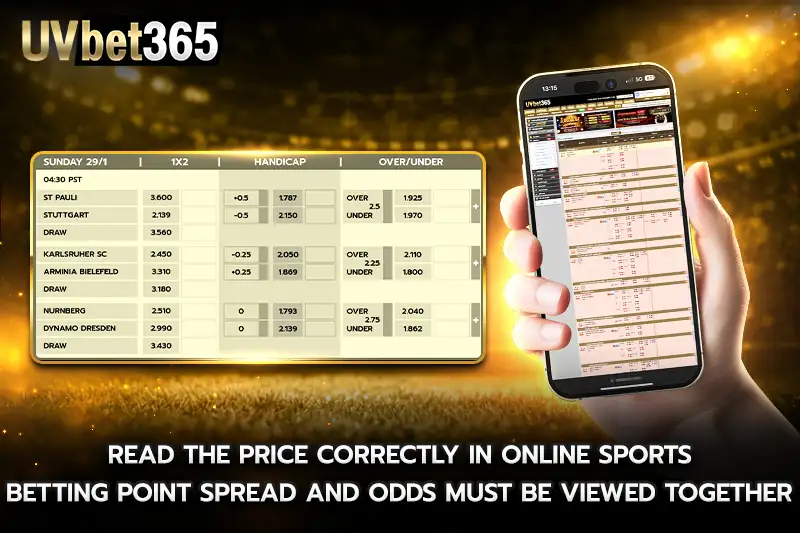
In Online Sports Betting, the handicap line defines the winning condition, while the line value or Betting Odds indicate the level of risk and potential return associated with that condition. Many users understand the line correctly but make mistakes by misreading the price—such as choosing quickly because the price looks attractive without fully understanding how much the line requires them to succeed or avoid losing.
Therefore, it is important to clearly separate the roles of these two elements:
- Handicap Line – The Condition to Pass the ticket
It answers questions such as:
- Must the team win by a margin?
- Is a narrow win enough?
- How much can they lose by and still cover the spread?
- Price / Betting Odds The Risk Level of That Condition
It answers the question: - “How difficult does the market consider it to pass this line?”
A Quick 3-Step Reading Process (Reduce Guesswork, Increase Accuracy)
- Check the line first: What result is required (win margin or non-loss)?
- Check the price: What level of risk are you accepting?
- Compare with your approach: Do you prefer protection or higher risk?
Why Can the Same Line Have Different Prices?
Because the market evaluates not only the line itself, but also the probability of covering it at a given moment. Odds adjust to balance selections on both sides. In simple terms, Betting Odds are used to prevent the market from becoming too one-sided.
This is crucial, as it prevents you from being influenced by numbers that only “look attractive.” Instead, return to the key question:
Is the condition required to cover the spread reasonable?
The relationship between line and price within Handicap aligns with the broader structure of ticket settlement in Online Betting, helping you interpret conditions more accurately.
Why Point Spreads Improve Selection Accuracy Creating Competitive Balance in Betting Terms
Point spreads improve accuracy because they shift the decision from “Who wins?” to “Who covers the spread?”
In mismatched contests, without a spread:
- Decisions become extreme (strong favorite with low return vs underdog with high risk)
With a spread:
- Decisions become structured and measurable
Examples:
- If you choose the favorite, you are not simply believing they will prevail, you believe they will “succeed beyond the line.”
- If you choose the underdog, you believe they will at least “avoid losing by too much” or manage the game closely enough to cover the range.
Importantly, the rate does not always mean “this unit is better.” More often, it reflects “this unit carries this no-loss option.” A stronger line usually corresponds with a different rate because the clause is harder to meet. A lighter line may shift the rate as the associated hazard decreases.
Therefore, accuracy in selecting a range does not come from identifying the “strongest team,” but from answering a more precise question:
Which type of outcome is likely enough to cover the line and is that rate worth the level of hazard I am willing to accept?
Common Mistakes in Online Sports Betting Misreading the Spread by Looking Only at the Raw Score
One of the main errors in Online Sports Betting is concluding outcomes based solely on the on-field prevail or loss, without calculating the result after applying the line advantage.
To correct this effectively, here are common mistakes and quick fixes:
- Forgetting to Adjust the cushion Before Concluding
- Symptom: Seeing a unit victory and assuming the slip wins.
- Fix: Create a new rule “Do not conclude until calculating the adjusted result.”
- Mixing Up Favorite and Underdog
- Symptom: Treating the plus/minus sign as just a number.
- Fix: Translate the sign into plain meaning every time:
- “Negative = giving points = must succeed by enough margin.”
- “Positive = receiving points = can lose narrowly and still cover.”
- Looking Only at the rate and Ignoring the Line
- Symptom: Choosing because the odds look attractive.
- Fix: Change the reading order:
- Check the line first (cover term) → then check the rate (risk level).
- Thinking the cushion “Guarantees” a Better Chance
- Symptom: Believing the cushion makes winning easier.
- Fix: Remember that the cushion only makes the matchup more balanced in terms of conditions; it does not change the real outcome of the game.
Before confirming a slip, ask yourself one simple question: “Am I betting on a team to victory, or betting on a team to cover the cushion?” If you can answer clearly, your mistakes will decrease significantly.
Short Scenario Examples Choosing Favorite or Underdog Without Guessing
Start by asking: “How much must the team win or avoid losing to cover the spread?” Then use the odds to evaluate the level of risk.
Note: The examples below present a decision framework, not advice to select a specific option.
Case A: High goal head start (Must Win by a Clear Margin)
If the line requires the favorite to succeed by more than a certain margin to cover, the requirement becomes stricter. You should ask, “Is there a strong reason for the game to end with a clear margin?” rather than simply, “Is this team stronger?”
One-line reading: If a narrow success does not cover, the spread requires a decisive victory.
Case B: Low goal head start (A Narrow Win Is Enough)
A lower line makes the covering requirement easier in terms of result, but the odds may reflect a different level of risk—for example, when the market views the match as highly competitive.
One-line reading: A low line is easier to cover, but always check the odds to understand the risk of a close contest.
Case C: Underdog Receiving Points (Cushion Against a Narrow Loss)
Choosing the underdog with added points provides a “cushion” against a narrow loss. You should ask, “How likely is a heavy loss?” because the cushion only protects against certain outcomes.
One-line reading: Underdog with points = strong protection in close games, but limited protection against heavy losses.
The core idea is this: You do not need deep knowledge of sport-specific rules to begin reading point spreads correctly. First understand the covering condition, then use the odds to evaluate the level of risk.
For cricket, reviewing team context and match dynamics before selecting a line can be further developed using a structured Cricket Prediction framework, helping ensure that your spread interpretation remains consistent and data-driven.
Conclusion from the Perspective of Online Sports Betting Handicap Is a Winning Condition That Must Be Read Together with the Price
In Online Sports Betting, remember this clearly: “The point spread = the winning condition,” and “The price = the level of risk.” They must be viewed together to select a spread accurately. A practical takeaway: start by reading the allowance line to understand how much each unit must succeed or prevent defeat by covering the slip. Then review the amount to assess whether the risk level is reasonable for that term. This way of thinking reduces emotional decision-making, minimizes mistakes caused by focusing only on the raw Score, and increases accuracy in selecting line offsets systematically without relying on guesswork.